ASEAN Plus Three Emergency Rice Reserve 

191255

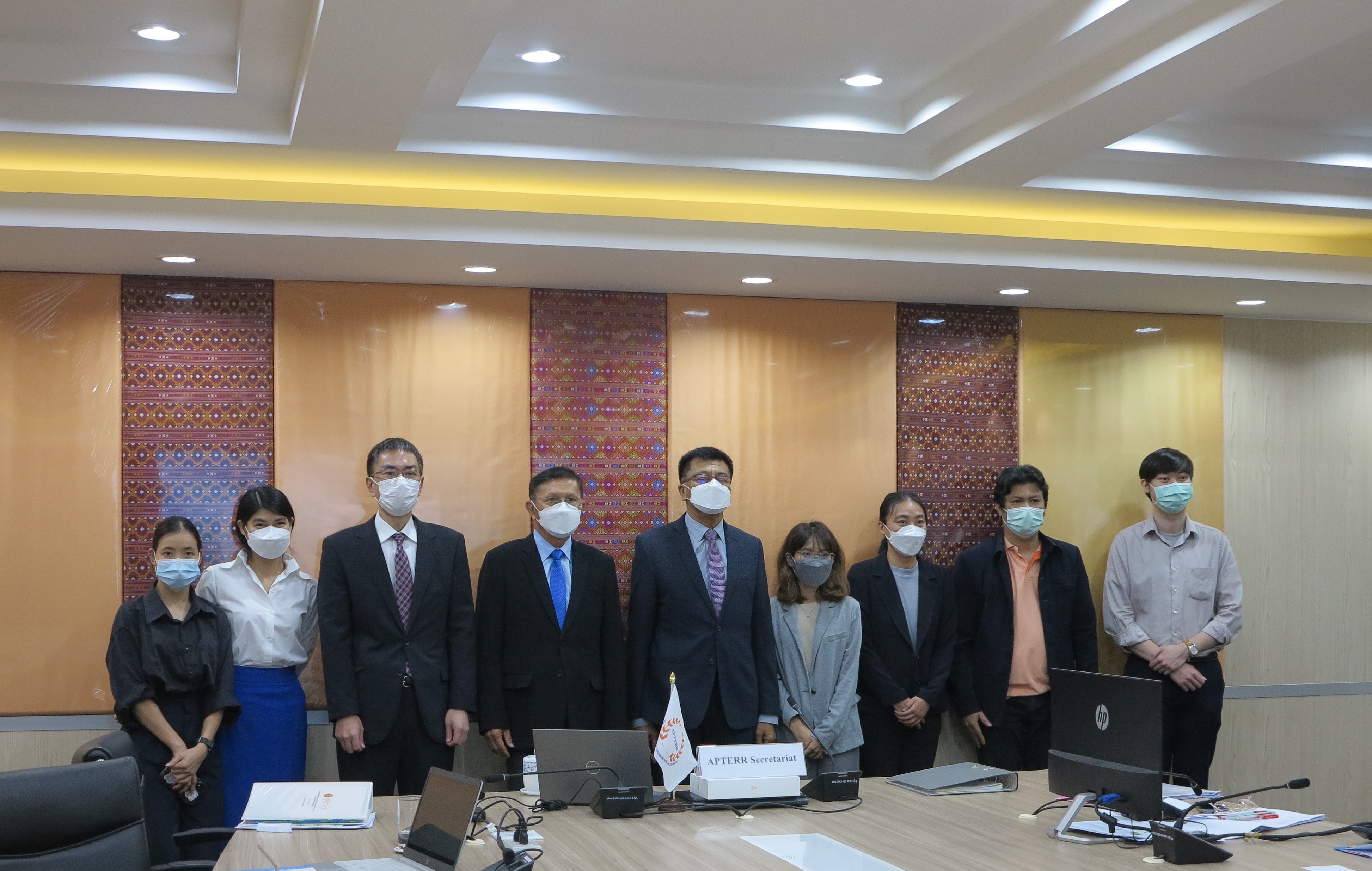
The virtual 10th Meeting of ASEAN Plus Three Emergency Rice Reserve (APTERR) Council ended with a great success on 25 March 2022 organised by the APTERR Secretariat, and hosted by the Singapore Food Agency (SFA), Singapore. The meeting was co-chaired by Mr. Kevin KHNG, Senior Director of International Relations Divisions, SFA and Mr. Taira Matsumoto, Director General of Crop Production Policy Department, Crop Production Bureau, Ministry of Agriculture, Forestry and Fisheries (MAFF) of Japan.


Several achievements of the APTERR were reported and approved in the meeting, especially the extension of financial contribution for the 3rd phase (2023-2027) to bolster regional food security through the APTERR mechanism. Furthermore, the APTERR Council expressed their appreciation to the current General Manager (GM) of the APTERR Secretariat, Mr. Chanpithya Shimphalee, for his hard work and dedication during six years of service in driving the APTERR Secretariat forward with strength and dignity, and also welcomed Mr. Choomjet Karnjanakesorn as a new GM who would take his position in May 2022.   


Beside the 13-APTERR member countries, representatives from the ASEAN Secretariat, the ASEAN Food Security Reserve Board (AFSRB) Secretariat, and the ASEAN Food Security Information System (AFSIS) Secretariat also attended this significant event.


.

 Photo credit: APTERR Secretariat,

Singapore Food Agency 



 Logo APTERR Eng 

 What is APTERR?


The ASEAN Plus Three Emergency Rice Reserve (APTERR) is a regional cooperation established under the APTERR Agreement signed by the Ministers of the Agriculture and Forestry of the ASEAN Plus Three at the 11th Meeting of the ASEAN Minister on Agriculture and Forestry Plus Three (AMAF+3) on 7 October 2011 in Jakarta, Indonesia. The APTERR was officially established itself as a permanent mechanism and also marked the official launch of the APTERR Secretariat office in Bangkok in 2013. 

 

We are keen to strengthen food security, poverty alleviation, and malnourishment eradication among its members without distorting normal trade, while the common goal of the APTERR Parties is the assurance of food security in the ASEAN+3 region. 


APTEERR Stock Overview APTEER Stock Marker Map with Animation

Current APTERR stock under Tier 3 in FY2025

**The pre-positioned stockpiled system under Tier 3 programme in FY 2025 to ensure a timely rice assistance to people affected by calamities

Current APTERR stock volume (MT)

Cambodia

275 MT

360 MT

Total :635 MT

Lao PDR

300 MT

302 MT

1,000 MT

Total :1,602 MT

Myanmar

375 MT

2,000 MT

Total :2,375 MT

Philippines

400 MT

Total :400 MT

Natural Disasters


Logo APTERR Eng

WEEKLY UPDATE ON NATURAL DISASTERS
IN ASEAN PLUS THREE

No. 475 792726210d1e7546b7ced88db6894424 

8 - 14 July 2026

  1. Indonesia
  2. Myanmar
  3. Philippines
  4. Thailand
  5. Viet Nam
  6. China
  7. Republic of Korea

Strong earthquake damaged Central Sulawesi, Indonesia. On 12 July 2026, a 5.1 - magnitude earthquake struck Central Sulawesi province in Indonesia at a depth of 10 km. The quake left one hospital patient dead during an evacuation, and damaged homes and public properties in towns, according to the Buol Disaster Mitigation Agency. Following the incident, authorities were continuing damage assessments, setting up shelters, and distributing emergency supplies to the affected people.

Source: AA. (2026, July 13). Magnitude 5.1 earthquake kills 1, damages buildings in Indonesia’s Central Sulawesi.

Prolonged flooding inundated western Myanmar, leaving three dead. Floods continued to affected western Myanmar, raising concerns over rising water levels in Rakhine and Chin states as of 11 July 2026. At least three people were reported dead, according to the humanitarian services of the Arakan Army. Meanwhile, around 200 houses and all paddy fields were submerged in some villages, causing widespread damage to livelihoods and agriculture.

Source: The Straits Times. (2026, July 11). Myanmar hit by deadly floods.

Super Typhoon Bavi wreaked havoc across Philippines. Super Typhoon Bavi entered the Philippine Area of Responsibility (PAR) on 8 July 2026 before gradually weakening as it moved northwest track across the Philippine Sea near North Luzon, the Philippines. Although the typhoon did not made landslide in the country, its outer rainbands triggered widespread flooding and landslides the Philippines. On Mindanao Island, flooding claimed one life in Malaybalay City landslides left 15 people dead in Sarangani and Lanao del. Furthermore, some classes across mainland Mindanao were suspended on 9 July 2026. Local disaster risk reduction and management personnel rescued residents trapped by floodwater while preemptive evacuations were issued in some high-risk areas due to potential flash floods.

Source: Gulf News. (2026, July 8). Monster typhoon Inday (Bavi) enters Philippines: signal No.1 raised over 7 areas in Luzon. Al Jazeera. (2026, July 10). Philippines landslides kill 15 as Typhoon Bavi threatens region. Inquirer.net. (2026, July 10). 1 dead as rains batter Mindanao; Inday heading to Northern Luzon.

Torrential rains continued to affect several regions of Thailand. On 8 July 2026, strong rainfall and winds damaged 22 houses in Nakhon Phanom Province in northeastern Thailand. Subsequently, on 13 July 2026, flash floods hit five districts in Chiang Rai Province in northern Thailand following 24 hours of cumulative rainfall, impacting 860 households. Local officers assessed the damage and provided assistance to ease the situation. Weather forecasts also warned that several regions of Thailand could continue to face heavy rain and possible flooding.

Source: ADINet. (2026, July 8). Thailand, storms and strong winds in Nakhon Phanom. ADINet. (2026, July 13). Thailand, flooding in Chiang Rai. Bangkok Post. (2026, July 13). Heavy rain expected to hit this week.

Extreme weather battered Viet Nam’s northern provinces. Heavy rains, thunderstorms, flash floods, and landslides affected northern Viet Nam from 8 to 11 July 2026, including Lao Cai, Lai Chau, Dien Bien, Son La, Tuyen Quang, and Thai Nguyen provinces. The disasters damaged 197 houses and forced the evacuation of 90 high-risk households. Moreover, over 935 hectares of crops were damaged, traffic was disrupted at 111 locations, and other facilities sustained damaged. The estimated losses in Son La alone reached 31.1 billion VND (around 1.2 million USD). Local authorities and residents were urged to remain on alert as further rainfall could trigger more hazards in vulnerable areas.

*1 USD = 25,916.67 VND

Source: Viet Nam News. (2026, July 12). Severe weather causes widespread damage across northern mountainous provinces.

Weakened Typhoon Bavi slammed eastern China after nearly two million people were evacuated. Despite weakening from typhoon to a tropical strom, Bavi made landfall in Yuhuan City in eastern China, on 11 July 2026, bringing heavy rain and violent winds that damaged roofs and tree branches. Nearly two million people were evacuated ahead of its arrival. Still, the storm caused severe disruptions. Two major railway stations in Hangzhou were suspend all services, and 327 flights at Xiaoshan International Airport were cancelled. In nearby Shanghai, more than 1,600 trains and 684 flights were also cancelled.

Source: Reuters. (2026, July 11). Typhoon Bavi makes landfall in eastern China’s Taizhou after nearly 2 million evacuated. Al Jazeera. (2026, July 12). Typhoon Bavi weakens to tropical storm as it slams into eastern China.

Heavy rain damaged central South Korea. Overnight downpours on 9 July 2026 battered central South Korea, including Chungcheong, North Jeolla, southern Gyeonggi, and Gangwon provinces. Anseong City in Gyeonggi recorded the highest total accumulated rainfall at 200.5 millimetres. According to the Ministry of the Interior and Safety, one person was reported missing, 662 residents were evacuated, and at least 256 facilities were damaged. In response, the Gyeonggi provincial government raised the emergency response level to Level 2, increasing staff to 54 people to bolster inspections of rain-related damage and emergency response efforts.


Source: The Korea Herald. (2026, July 9). Overnight downpours batter central S. Korea, at least 1 missing. Yonhap News Agency. (2026, July 9). (LEAD) Heavy downpours cause flooding, damage, forcing over 600 to evacuate.

Rice Situation


Logo APTERR Eng

WEEKLY UPDATE ON RICE SITUATIONS 
IN ASEAN PLUS THREE

No. 475 792726210d1e7546b7ced88db6894424 

8 - 14 July 2026

  1. Indonesia
  2. Malaysia
  3. Philippines

Indonesia Eyes Rice Exports as Talks Continue with Malaysia and Singapore. Indonesia's state logistics agency, Bulog, is continuing negotiations with Malaysia and Singapore on planned rice exports, focusing on pricing and commercial terms. Bulog is discussing a proposed 200,000-tonne rice export to Malaysia and a 10,000-tonne shipment to Singapore, with talks ongoing as it awaits Malaysia's readiness to receive an Indonesian delegation. Bulog said President Prabowo Subianto has instructed that any export agreements must safeguard the interests of Indonesian farmers while supporting the country's broader economic goals.

Source: The Star. (2026, July 13). Indonesia continues talks with Malaysia and Singapore on proposed rice exports.

Malaysia Strengthens Food Security as Rice Stocks Remain Stable. According to the Malaysia's Economy Minister, the country's food supply remains stable despite global geopolitical and weather-related uncertainties, with national rice reserves sufficient to meet domestic demand for 6 months and no change to local white rice prices. To support paddy farmers facing higher production costs and changing weather, the government has disbursed 45.98 million MYR (11.27 million USD) to 118,908 farmers and is diversifying fertiliser sources, with a Fertiliser Bill planned for early 2027 to strengthen governance and supply resilience. In addition, the government also acknowledged challenges facing the plastics industry from rising raw material and logistics costs. Authorities will review industry proposals while prioritising food and energy security, reducing unnecessary business costs, expanding market access, attracting investment, and accelerating technology adoption to strengthen Malaysia's long-term economic competitiveness.

*1 USD = 4.08 MYR

Source: The Star. (2026, July 13). Malaysia's rice supply stable despite current global conditions, says Akmal Nasrullah.

Philippines' First-Half Rice Imports Hit Record 2.75 million tonnes. The Philippines imported a record 2.75 million tonnes of rice in the first half of 2026, up 20.1 percent from 2025 and already reaching 57 percent of the government's full-year import target of 4.8 million tonnes. The Department of Agriculture said the higher imports are aimed at ensuring adequate domestic supply, stabilising rice prices, and preparing for potential El Niño impacts amid rising fuel and fertiliser costs. Despite the increase in imports, domestic rice production remains under pressure, prompting the government to maintain sufficient stocks at affordable prices. Officials also noted that lower global rice prices have created an opportunity to import rice at competitive costs, while any decision on import restrictions will be made by the Agriculture Secretary. According to the US Department of Agriculture (USDA), the Philippines will remain the world's largest rice importer in 2026, with imports expected to reach 5.7 million tonnes.

Source: VietnamPlus. (2026, July 10). Philippines posts record rice imports in first half of 2026.

Text Here