ASEAN Plus Three Emergency Rice Reserve 

191255

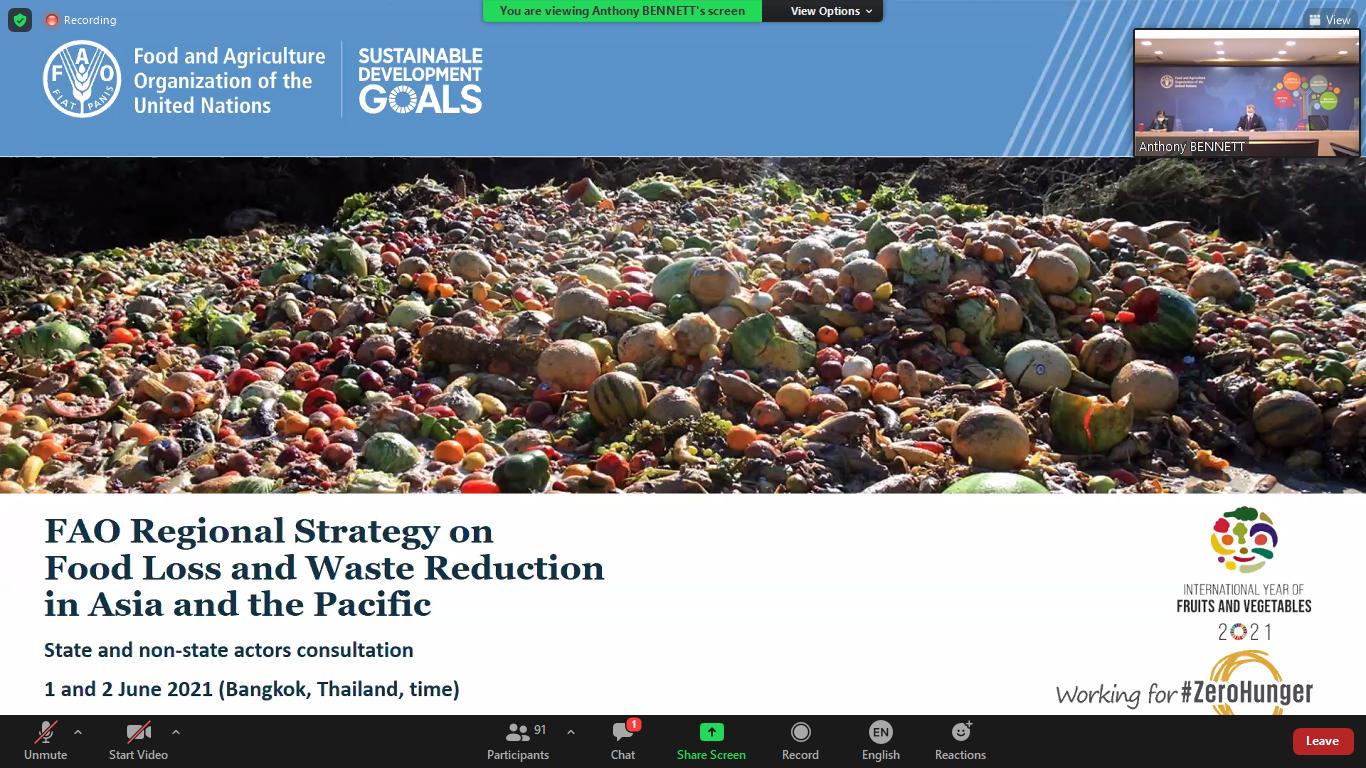
Ms.Nattavadee Sraprathum and Mr.Pirapat Shimphalee as the representatives from the APTERR Secretariat participated in the ‘Multi-stakeholder Consultation on the Draft FAO Regional Strategy on Food Loss and Waste Reduction in Asia and the Pacific’ virtually held during 1 – 2 June 2021 by Food and Agriculture Organisation (FAO) of the United Nations (UN).

The consultation focused on the first multi-disciplinary and multi-stakeholder FAO Regional Strategy on Food Loss and Waste Reduction in Asia and the Pacific and its roadmap for implementation to close the region’s gaps in data and performance as well as to achieve the target of Sustainable Development Goal (SDG) 12.3.


The APTERR Secretariat realised that minimising food loss and waste could be seen as a channel toward achieving other objectives, for instance, improving food security and nutrition. Thus, to go fast and far along with other regions, the APTERR wholeheartedly supports the FAO regional strategy as the pathway to achieve the goals of FAO’s Save Food Initiative as well as the APTERR’s goals.


There were about 90 delegates from several countries attending this event to exchange views and experiences on food loss and waste reduction. The consultation had the fruitful outcomes and scaled up the collaboration between governmental and non-governmental agencies.


 Logo APTERR Eng 

 What is APTERR?


The ASEAN Plus Three Emergency Rice Reserve (APTERR) is a regional cooperation established under the APTERR Agreement signed by the Ministers of the Agriculture and Forestry of the ASEAN Plus Three at the 11th Meeting of the ASEAN Minister on Agriculture and Forestry Plus Three (AMAF+3) on 7 October 2011 in Jakarta, Indonesia. The APTERR was officially established itself as a permanent mechanism and also marked the official launch of the APTERR Secretariat office in Bangkok in 2013. 


We are keen to strengthen food security, poverty alleviation, and malnourishment eradication among its members without distorting normal trade, while the common goal of the APTERR Parties is the assurance of food security in the ASEAN+3 region. 


APTEERR Stock Overview APTEER Stock Marker Map with Animation

Current APTERR stock under Tier 3 in FY2025

**The pre-positioned stockpiled system under Tier 3 programme in FY 2025 to ensure a timely rice assistance to people affected by calamities

Current APTERR stock volume (MT)

Cambodia

275 MT

360 MT

Total :635 MT

Lao PDR

300 MT

302 MT

1,000 MT

Total :1,602 MT

Myanmar

375 MT

2,000 MT

Total :2,375 MT

Philippines

400 MT

Total :400 MT

Natural Disasters


Logo APTERR Eng

WEEKLY UPDATE ON NATURAL DISASTERS
IN ASEAN PLUS THREE

No. 460 792726210d1e7546b7ced88db6894424 

25 - 31 March 2026

  1. Indonesia
  2. Viet Nam
  3. China
  4. Japan

Two earthquakes struck Indonesia, with no damage. On 29 March 2026, a 6.5-magnitude earthquake struck Maluku and a 2.6-magnitude earthquake struck Kolaka in Southeast Sulawesi, Indonesia. No damage or casualties were reported, and there was no risk of a tsunami. The tremor was felt by several residents, similar to a heavy vehicle passing by. Local authorities continued to monitor the situation in both areas.

Source: The Star. (2026, Mar 29).  Two earthquakes strike eastern Indonesia on Sunday (March 29), says BKMG.

Extreme weather wreaked havoc in Viet Nam. As of 31 March 2026, severe weather, including hail, thunderstorms, strong winds, and lightning, affected Hanoi and northern Viet Nam during 29-30 March 2026. Four fatalities were reported, with two in Tuyen Quang and Son La due to lightning strikes, and two in Quang Ninh after strong winds capsized a boat. Nine people were injured, including six in Lao Cai and one each in Lang Son, Thai Nguyen, and Hanoi. A total of 13 houses were destroyed, while 6,551 others were damaged, with the most severe impacts recorded in Lao Cai and Cao Bang. Agricultural areas and public infrastructure were also affected. Local authorities promptly assisted affected areas and advised residents to continue monitoring the situation.

Source: VnExpress. (2026, Mar 31). 4 dead, 9 injured as hailstorms, thunderstorms hit Hanoi and nearby provinces.

Thunderstorms and hailstorms disrupted flights and trains in China. As of 30 March 2026, heavy thunderstorms and hailstorms caused flight disruptions in Guangzhou and Shenzhen, China, affecting thousands of passengers. At Baiyun International Airport in Guangzhou, more than 120 inbound and outbound flights were cancelled and over 390 delayed. At Bao’an International Airport in Shenzhen, 90 flights were cancelled, more than 310 delayed, and seven diverted. Flights to and from eastern, central, and northern China were particularly affected. High-speed and intercity railway services were also disrupted. Local authorities in Guangzhou issued thunderstorm alerts for all 11 districts and hail alerts for nine districts, including Yuexiu.

Source: China Daily. (2026, Mar 30).  Severe weather causes widespread flight delays, cancellations in Guangzhou and Shenzhen.

A 6.4-magnitude earthquake hit Japan’s northeast coast, with no tsunami risk. As of 27 March 2026, a 6.4-magnitude earthquake struck off the Sanriku coast, east of Iwate Prefecture, northeastern Japan, on 26 March 2026. The strongest shaking was recorded at intensity 4 on the Japanese scale in Morioka in Iwate, while Hakodate in Hokkaido and parts of Aomori Prefecture recorded intensity 3. Minor sea level changes could occur along the coast of Japan, but no damage was reported and no tsunami was expected.

Source: The Standard. (2026, Mar 27). Strong shallow earthquake hits off Japan’s northeast coast, no tsunami threat.

Rice Situation


Logo APTERR Eng

WEEKLY UPDATE ON RICE SITUATIONS 
IN ASEAN PLUS THREE

No. 460 792726210d1e7546b7ced88db6894424 

25 - 31 March 2026

  1. Philippines
  2. Thailand
  3. Viet Nam

The Philippines plans to set a temporary price cap on rice imports. The Philippines is planning to impose a temporary price cap on imported rice to address rising food costs driven by higher global fuel prices amid Middle East tensions. According to the Department of Agriculture, the National Price Coordinating Council has launched a proposal to set the maximum prices of imported rice at 50 PHP (0.83 USD) per kilogramme for imported rice, which is effective for 30 days. This measure is aimed at controlling the crucial price increases and preventing market abuse, as rice is the country’s key food staple.

*1 USD = 60.24 PHP

Source: Bloomberg. (2026, March 28). Philippines Seeks 30-Day Price Cap on Rice as Fuel Costs Surge.

Thai farmers struggle with fuel shortage and rising fuel prices. Thai farmers are currently struggling with a severe diesel shortage, which disrupts the farming process, and rising diesel prices have increased the rice production costs. The crisis, driven by Middle East tensions, has disrupted energy supplies across Thailand and nearby countries that depend on imports. The shortages are not only affecting the rice sector, but also including transport and fisheries. Farmers and fishers are among the hardest hit, with concerns that a continued fuel shortage could halt production. The increase in diesel prices, rising from 29.94 THB (0.91 USD) to 38.94 THB (1.19 USD) per liter, has raised serious concerns about future harvests as more fuel will be needed during the upcoming harvest season. Experts warn of long-term impacts, including fertilizer shortages and rising food production costs, potentially worsening food insecurity in the region. Although the Thai government is launching support measures such as price support for rice and fertiliser subsidies, many farmers remain worried about sustaining their livelihoods.

*1 USD = 32.75 THB

Source: Thailand Business News. (2026, March 31). Soaring Fuel Prices Threaten Livelihoods of Thailand’s Rice Farmers.

Rice exports have been delayed due to Middle East tensions. Viet Nam's rice exports are being affected by rising shipping costs and higher insurance premiums caused by tensions in the Middle East. Shipping times have increased from 10 to 15 days, while domestic shipping costs have risen from 20,000 VND (0.8 USD) to 30,000 VND (1.2 USD). The report, citing the Director General of the Agency of Foreign Trade under the Ministry of Industry and Trade, stated that exporters are facing container shortages and disruptions in shipping, forcing them to renegotiate contracts, delay shipments, or reduce new orders. According to the Ministry of Agriculture and Environment, Vietnam's paddy output in 2026 is expected to reach approximately 45.6 million tonnes, with 7.73 million tonnes available for export.

*1 USD = 25,000 VND

Source: Xinhua. (2026, March 30). Vietnam rice exports face delays amid Middle East tensions.

Text Here