ASEAN Plus Three Emergency Rice Reserve 

191255

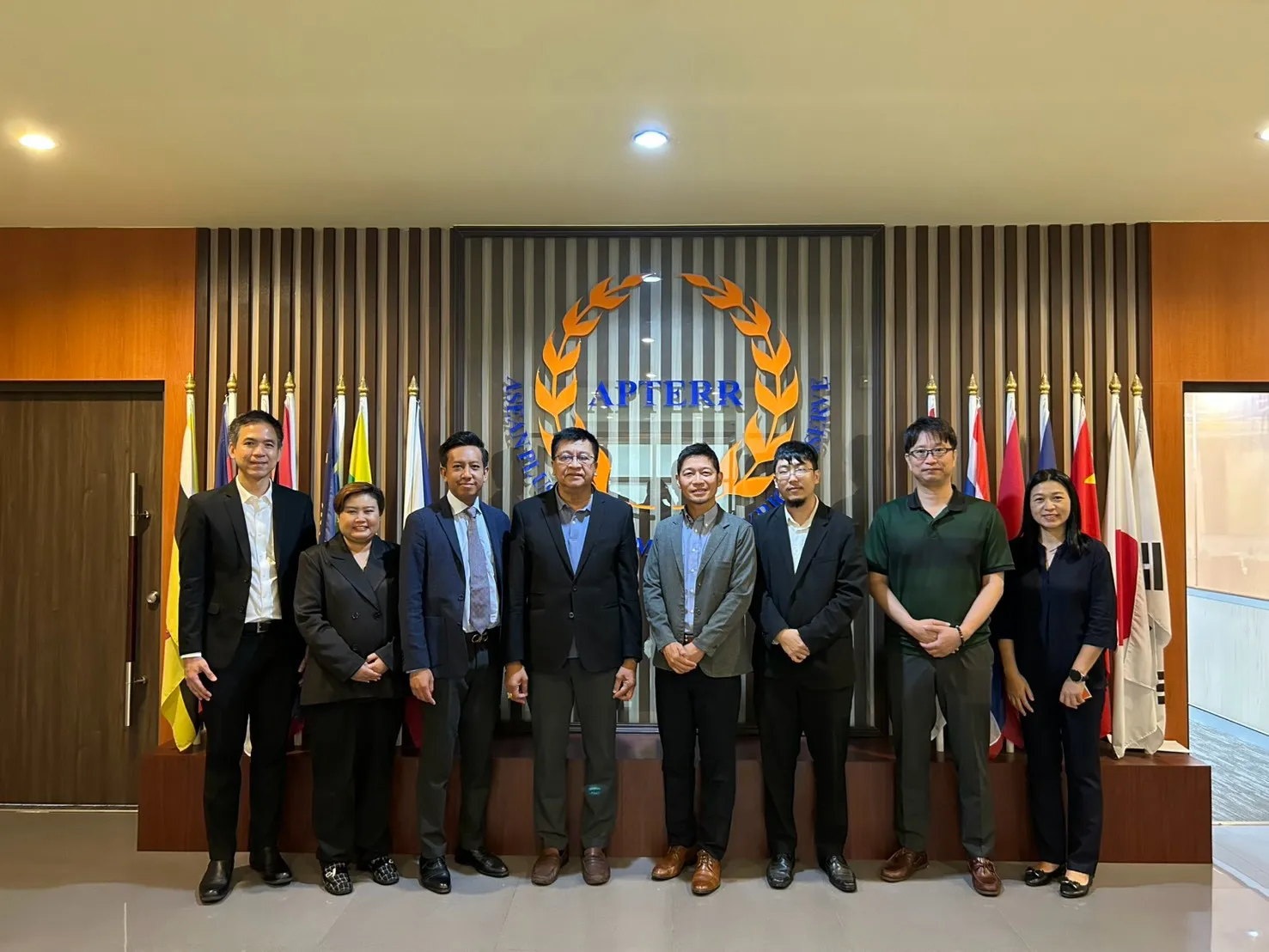
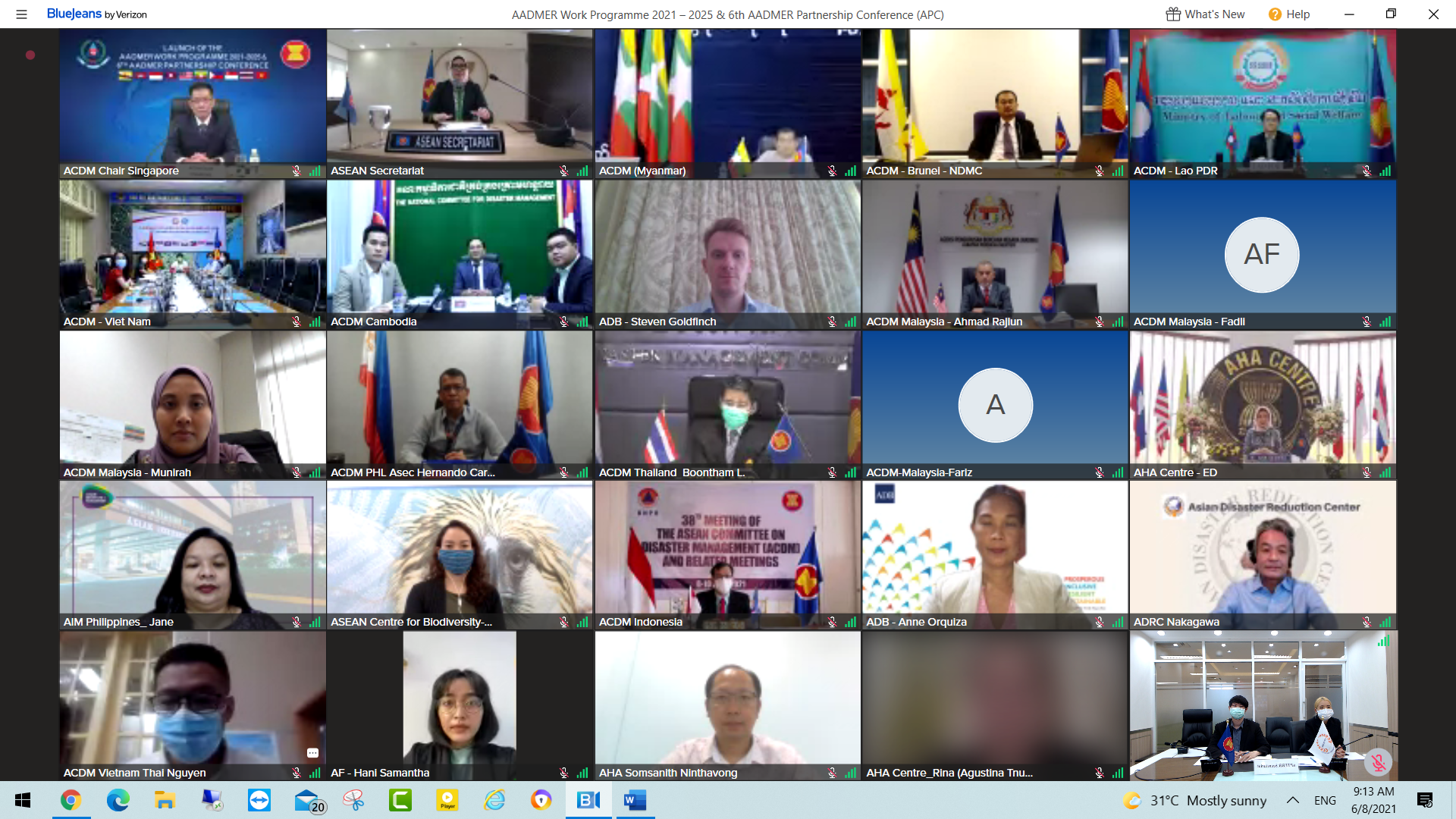
On 8 June 2021, the representatives from the APTERR Secretariat, Ms. Thortawan Thanormthin and Mr. Pirapat Shimphalee, participated in the Launch of the AADMER Work Programme 2021-2025 and the 6th AADMER Partnership Conference via a virtual conference. The meeting was organised by the ASEAN Committee on Disaster Management (ACDM) and also attended by numerous distinguished delegates from ASEAN as well as the ACDM’s partners.

On this occasion, the meeting acknowledged with great appreciation the launch of the new ASEAN Agreement on Disaster Management and Emergency Response (AADMER) Work Programme (AWP) 2021-2025, aiming to build a more disaster-resilient ASEAN community. Another main event of the meeting was the pledging from interested ACDM’s partners to support the implementation of AWP through its five priorities and outputs for strengthening the coordinated regional disaster management capacities.


The APTERR is one of implementing mechanisms playing a significant role in providing food preparedness and response to the emergency and for other humanitarian purposes via its effective rice assistance programmes of Tier 1, 2 and 3. With united effort from various key actors, a more adaptive, inclusive and resilient ASEAN region could be considerably achieved.


 Logo APTERR Eng 

 What is APTERR?


The ASEAN Plus Three Emergency Rice Reserve (APTERR) is a regional cooperation established under the APTERR Agreement signed by the Ministers of the Agriculture and Forestry of the ASEAN Plus Three at the 11th Meeting of the ASEAN Minister on Agriculture and Forestry Plus Three (AMAF+3) on 7 October 2011 in Jakarta, Indonesia. The APTERR was officially established itself as a permanent mechanism and also marked the official launch of the APTERR Secretariat office in Bangkok in 2013. 


We are keen to strengthen food security, poverty alleviation, and malnourishment eradication among its members without distorting normal trade, while the common goal of the APTERR Parties is the assurance of food security in the ASEAN+3 region. 


APTEERR Stock Overview APTEER Stock Marker Map with Animation

Current APTERR stock under Tier 3 in FY2025

**The pre-positioned stockpiled system under Tier 3 programme in FY 2025 to ensure a timely rice assistance to people affected by calamities

Current APTERR stock volume (MT)

Cambodia

275 MT

360 MT

Total :635 MT

Lao PDR

300 MT

302 MT

1,000 MT

Total :1,602 MT

Myanmar

375 MT

2,000 MT

Total :2,375 MT

Philippines

400 MT

Total :400 MT

Natural Disasters


Logo APTERR Eng

WEEKLY UPDATE ON NATURAL DISASTERS
IN ASEAN PLUS THREE

No. 450 792726210d1e7546b7ced88db6894424 

7 - 13 January 2026

  1. Indonesia
  2. Malaysia
  3. Philippines
  4. Japan

Severe flooding wreaked havoc in Indonesia. Torrential rainfall on 7 January 2026 triggered severe flooding in North Halmahera regency, North Maluku province, in central-eastern Indonesia. Reports indicate that one person died, more than 282 people were evacuated from Tehowa Village, and a total of 5,333 people were affected. Additionally, 20 houses were severely damaged, three were moderately or slightly damaged, and a total of 1,216 houses were inundated. Several bridges and roads were cut off in multiple locations.

Source: Relief Web. (2026, Jan 9).  Indonesia-Floods, update (BNPB, BMKG) (ECHO Daily Flash of 9 January 2026-Indonesia).

Flood and landslides shut down schools in Malaysia. As of 13 January 2026, floods and landslides led to school closures in Sabah and Sarawak, Malaysia. In Sabah, seven schools were closed, affecting a total of 908 students across three districts, namely Beaufort, Tenom, and Kota Kinabalu. Although weather conditions improved across most of Sabah, Beaufort remained the only district still affected by flooding, with 366 people from 138 families across 10 villages. In Sarawak, 28 schools in two districts, Tatau and Sebauh, were affected. No damage was reported at the affected schools.

Source: Asia News Network. (2026, Jan 13).  Floods and landslides shut schools in Malaysia’s Sabah, Sarawak.

Mayon Volcano eruption in the Philippines forced thousands of people to evacuate. On 8 January 2026, Mayon Volcano in Albay province on Luzon Island, the Philippines was erupted, prompting the evacuation of around 963 families, comprising 3,516 people from 13 villages located at the foot of the volcano. The alert level was raised to Level 3 due to an ongoing magmatic eruption of a summit lava dome, with an increased likelihood of lava flows and hazardous pyroclastic density currents that could affect the upper to middle slopes of the volcano. Explosive activity may occur within days to weeks.

Source: Viet Nam News. (2026, Jan 8).  Nearly 1,000 families in Philippines evacuated as Mayon volcano erupts.

Heavy snow threw flights into chaos across Japan. On 11 January 2026, heavy snow and strong winds affected large parts of Japan, disrupting air travel. Nearly 2,000 passengers were affected by the cancellation of 58 domestic flights operated by Japan Airlines, while approximately 2,800 passengers were impacted by the cancellation of 43 domestic flights operated by All Nippon Airways. The disrupted routes included services between Osaka Itami and Tajima, Haneda and Tottori, as well as Toyama and Haneda. Severe winter weather was expected to continue in many areas on 12 January 2026, with heavy snowfall and strong winds likely to cause further transport disruptions.Travelers were advised to closely monitor flight updates.

Source: VnExpress. (2026, Jan 12). Dozens of flights canceled across Japan amid heavy snow.

Rice Situation


Logo APTERR Eng

WEEKLY UPDATE ON  ASEAN PLUS THREE
RICE SITUATIONS 

No. 449 792726210d1e7546b7ced88db6894424 

24 December 2025 - 6 January 2026

  1. Indonesia
  2. Philippines
  3. Viet Nam

Indonesia stopped importing agricultural products, including rice, in 2026. Indonesia has announced a complete ban on rice, table sugar, and corn imports in 2026, citing rising domestic production and a push for national food self-sufficiency. The government has also scrapped plans to import industrial-grade rice, aiming to force manufacturers to source raw materials from local farmers. The policy aims to protect farmers’ and breeders’ incomes and strengthen the domestic supply chain. Officials say they are trying to improve yield quality and processing standards by increasing local sourcing. Additionally, the government believes that domestic surpluses will be sufficient to maintain price stability and ensure food security. The 2026 National Food Balance will serve as the roadmap for guiding the implementation of these measures and monitoring Indonesia’s transition toward full agricultural independence.

Source: ANTARA News. (2026, January 1). Indonesia halts rice, sugar, corn imports in 2026.

The Department of Agriculture will focus on fair rice prices, the P20 rice programme, and FMRs in 2026. The Department of Agriculture (DA) prioritises fair rice prices, the PHP20 programme, and the fast-tracking of farm-to-market roads (FMRs) construction in 2026. According to the Agriculture Secretary, these measures aim to sustain rice production, keep food affordable, and improve farmers’ market access. The DA will continue the National Food Authority’s procurement at 17 PHP (0.29 USD) per kilo for wet rice and 21 PHP (0.36 USD) per kilo for dry rice to support farmers. Moreover, the government works with industry sectors to prevent import surges from depressing prices. Rice imports were capped at 3.5 million metric tonnes in 2025, down from 4.8 million tonnes in 2024. In addition, the PHP20-per-kilo rice programme under “Benteng Bigas, Meron Na!” will be launched in 2026 to support up to 15 million households. The DA will implement a 33 billion PHP (approximately 0.56 billion USD) farm-to-market road project, aiming to reduce post-harvest losses, lower transport costs, and improve market access, thereby boosting rural incomes.

*1 USD = 59.12 PHP

Source: Philippines News Agency. (2026, January 1). DA vows to prioritize fair palay prices, P20 rice program, FMRs.

Viet Nam exported 7.85 million tonnes of rice in 2025, valued at 4.02 billion USD. According to the Ministry of Agriculture and Environment, Viet Nam exported rice total of 7.85 million tonnes in 2025, earning 4.02 billion USD. The Volume and value of exported rice have declined year-on-year, with export volume down 12.7 percent and revenue falling 29.4 percent, reflecting lower prices and weaker demand from traditional markets. Due to slowing shipments to key buyers such as the Philippines and Indonesia, Vietnam is shifting its export strategy toward high-quality rice and specialty varieties, including the award-winning ST25 and Japonica rice, such as the European Union, Japan, the United States, and China.

Source: VnEconomy. (2026, January 5). Vietnam exports 7.85 million tons of rice in 2025.

Text Here