ASEAN Plus Three Emergency Rice Reserve 

IMG 20181204 085748

The APTERR Secretariat participated the roundtable meeting on the Tier 3 programme and visited the disaster-prone areas as well as the warehouses in Iloilo, the Philippines. The meeting was hosted by the National Food Authority (NFA) of the Philippines and presided by NFA’s Deputy Administrator for Marketing Operations Attorney Judy Carol L. Dansal. The representatives from the Embassy of Japan in the Philippines also attended in this roundtable meeting.


Main issues of discussion included the food security situation in the Philippines and the steps of work implementation of ongoing Tier 3 programme in the Philippines under Japan’s 560-MT rice contribution.  The result of this roundtable meeting would help build a mutual understanding among relevant agencies on carrying out the Tier 3 programme implementation in the same direction to respond to the needs of our people in time emergency smoothly and effectively.


The APTERR Secretariat also inspected the NFA’s warehouse where will be stored the APTERR rice and the Port of Iloilo to ensure a smooth delivery of the rice.  Apart from this, the APTERR Secretariat visited the disaster-prone areas in Panay Island.


During the super typhoon Haiyan hit the Philippines in 2013, the APTERR also provided 580 MT of rice assistance contributed by Japan to almost 20,000 affected households in Iloilo, Capiz and Aklan provinces in Panay island.


 Logo APTERR Eng 

 What is APTERR?


The ASEAN Plus Three Emergency Rice Reserve (APTERR) is a regional cooperation established under the APTERR Agreement signed by the Ministers of the Agriculture and Forestry of the ASEAN Plus Three at the 11th Meeting of the ASEAN Minister on Agriculture and Forestry Plus Three (AMAF+3) on 7 October 2011 in Jakarta, Indonesia. The APTERR was officially established itself as a permanent mechanism and also marked the official launch of the APTERR Secretariat office in Bangkok in 2013. 


We are keen to strengthen food security, poverty alleviation, and malnourishment eradication among its members without distorting normal trade, while the common goal of the APTERR Parties is the assurance of food security in the ASEAN+3 region. 


APTEERR Stock Overview APTEER Stock Marker Map with Animation

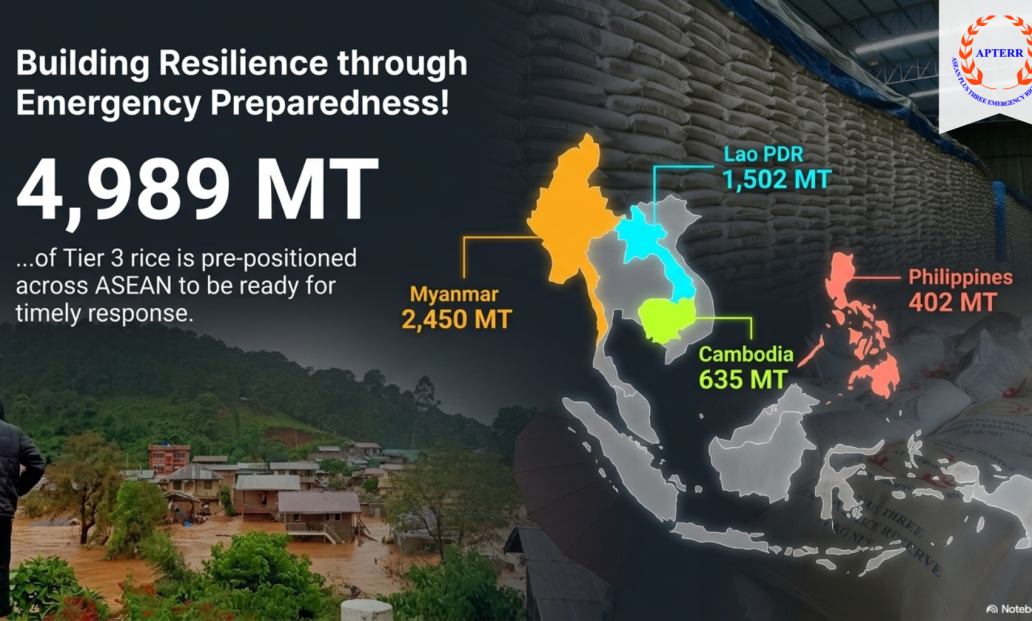
Current APTERR stock under Tier 3 in FY2025

**The pre-positioned stockpiled system under Tier 3 programme in FY 2025 to ensure a timely rice assistance to people affected by calamities

Current APTERR stock volume (MT)

Cambodia

275 MT

360 MT

Total :635 MT

Lao PDR

300 MT

302 MT

1,000 MT

Total :1,602 MT

Myanmar

375 MT

2,000 MT

Total :2,375 MT

Philippines

400 MT

Total :400 MT

Natural Disasters


Logo APTERR Eng

WEEKLY UPDATE ON NATURAL DISASTERS
IN ASEAN PLUS THREE

No. 464 792726210d1e7546b7ced88db6894424 

22 - 28 April 2026

  1. Indonesia
  2. Thailand
  3. Viet Nam
  4. Japan

Flooding affected residents across Indonesia. Torrential rainfall triggered flooding in Indonesia on 22 April 2026. In North Sumatra, one person was injured and around 600 people were affected, according to the report as of 24 April 2026. Three houses, one bridge, and one school were destroyed, while 150 houses were damaged. In North Sulawesi, 16 people were displaced and 236 people living in 59 houses were affected. In East Java, flooding caused by the overflow of the Welang River Basin affected 5,420 people across 1,355 houses. In South Jakarta, 2,513 people living in 937 houses were affected due to the overflow of the Ciliwung River.

Source: ReliefWeb. (2026, Apr 24).  Indonesia - Severe weather and floods (BMKG, NOAA-CPC, media) (ECHO Daily Flash of 24 April 2026).

Summer storms claimed one life in Thailand. Severe storms affected several provinces in Thailand. In Phetchabun province, one house was damaged by strong winds on 22 April 2026, with no injuries or casualties reported. In Udon Thani province, one person died after crashing into a fallen tree on 23 April 2026, while 30–40 houses lost their roofs and others were damaged by falling trees. In Nakhon Ratchasima province, strong winds and heavy rainfall on 24 April 2026 damaged infrastructure, including two multi-purpose dome structures, a worker accommodation building, three houses, and a rice barn. Several large tree fell across roads. Flooding caused by heavy rain also disrupted transportation for small vehicles.

Source: Bangkok Post. (2026, Apr 23).  Roof flies off house in heavy storm; Thaiger. (2026, Apr 25).  Udon Thani storm kills frog hunter, destroys 40 homes;The Nation. (2026, Apr 25).  Summer storm tears through Korat, leaving severe damage as more rain looms.

Hailstorm and downpour struck Viet Nam. On 22 April 2026, a hailstorm and heavy rainfall affected at least 12 wards and communes in Lao Cai province, Viet Nam. In Sa Pa Ward, hailstone battered pathway near the summit of Fansipan, the highest mountain in Viet Nam. Three houses lost their roofs. In Sin Cheng Commune, a teaching housing facility and one household were completely unroofed while nearby houses were also damaged. The agricultural production and infrastructure, including roads and schools were also impacted. The resources were mobilised to recovery the damages

Source: Tuoi Tre News. (2026, Apr 23). Hailstorm batters Fansipan peak in northern Vietnam.

A 6.2-magnitudes earthquake hit northern Japan. On 27 April 2026, a 6.2-magnitude earthquake rattled Hokkaido, northern Japan. No tsunami alert was issued. The quake registered an upper 5 on the Japanese seismic intensity scale in town of Urahoro and a lower 5 in town of Niikappu and Hokkaido. Authorities also confirmed that the event was not related to the advisory on a potential megaquake, which had been issued following a 7.7-magnitude earthquake in Iwate Prefecture on 20 April 2026.

Source: The Japan Times. (2026, Apr 26). Magnitude 6.2 quake shakes Hokkaido.

Rice Situation


Logo APTERR Eng

WEEKLY UPDATE ON RICE SITUATIONS 
IN ASEAN PLUS THREE

No. 464 792726210d1e7546b7ced88db6894424 

22 - 28 April 2026

  1. Indonesia
  2. Thailand
  3. Viet Nam

Indonesia aims to achieve self-sufficiency in eight key food commodities. After achieving rice self-sufficiency by the end of 2025, Indonesia aims for a bigger milestone: achieving self-sufficiency in eight key food commodities, including rice, by June 2025, despite climate challenges. The rice stock is projected at 31.3 million tonnes, exceeding the 15.4 million tonnes needed. Moreover, Indonesia has also begun exporting products such as shallots and poultry, signaling a shift toward becoming a regional supplier. Officials say rising production and reserves will reduce import reliance and strengthen the country’s role in ASEAN amid climate volatility and global geopolitical uncertainties.

Source: Vietnam Plus. (2026, April 23). Indonesia forecasts surplus of eight key agricultural commodities by mid-2026.

The Ministry of Commerce announced measures to support farmers. Thailand’s Commerce Ministry has announced new measures to support rice farmers facing rising costs, fluctuating prices, and global market uncertainty. According to the Minister of Commerce, the government will adopt an integrated strategy covering production, processing, and marketing, including a market-driven purchasing system to stabilise prices during peak harvests. Real-time rice dashboards to monitor domestic supply and demand, allowing for more precise production and sales planning. Moreover, the Ministry of Agriculture will focus on developing rice varieties and promoting improved farming practices to improve the nation’s rice productivity. In addition, the government is also expanding processing capacity through community projects to help farmers produce higher-value goods and delay sales. And the additional support includes paddy fairs, improved market access, and a fertiliser discount programme of up to 300 THB (9.23 USD) per sack. Thailand is targeting rice exports of more than seven million tonnes this year.

*1 USD = 32.50 THB

Source: Bangkok Post. (2026, April 27). Rice prices in Asia soar as Iran war fallout threatens supply.

Viet Nam rice exporter faces pressure despite strong harvest. Rice harvesting in Vietnam’s key provinces, including An Giang and Vinh Long, has finished with strong yields, reaching 6.7–7.8 tonnes per hectare, but a supply glut is straining storage and cash flow. The rice exporters are currently facing disruption due to Middle East tension, which is delaying rice shipment and payment, while the costs are rising, including borrowing costs and storage fees. Meanwhile, rising fuel costs are increasing harvesting, transport, and production expenses, while stricter trading requirements have slowed buying and caused local stockpiles. This has reduced the competitiveness of Vietnamese rice, with key markets like the Philippines delaying purchase at lower prices. In addition, experts suggest that the focus should shift from increasing output to improving quality. Cooperative farming models and high-quality rice such as ST25 are helping reduce costs and boost value, with demand expected to recover in the coming months, particularly from the Philippines and African markets.

Source: The Saigon Times. (2026, April 22). Vietnam rice exporters under pressure despite ample supply.

Text Here